
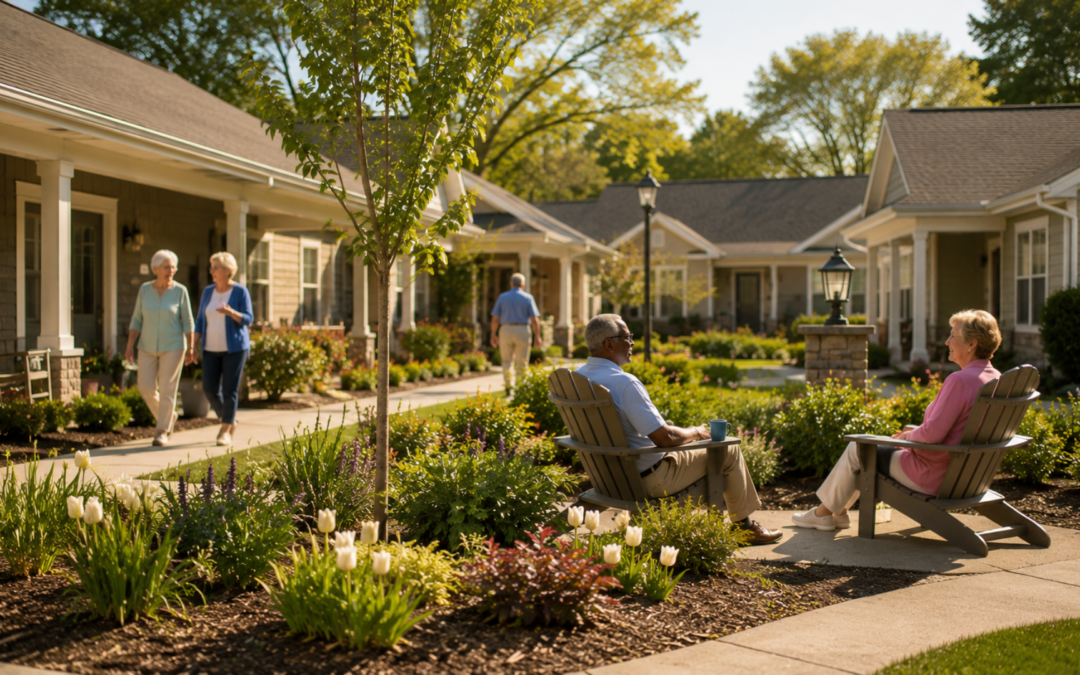
Downsizing South Suburbs homeowners often assume their only options are staying put or moving into a traditional senior facility. Cohousing offers a genuinely different third path for anyone tired of those two extremes. It combines a private home with real, built-in community, and more homeowners are discovering it every year.
What Cohousing Actually Is
Cohousing is a planned community where residents own or rent private homes arranged around shared common spaces, a model that is still fairly new to most of Chicagoland. According to the Cohousing Association of the United States, residents typically eat together several nights a week in a shared common house. Nobody requires you to attend, though. You keep your own kitchen, your own bathroom, and your own front door that locks.
Senior cohousing communities restrict residency to adults over a certain age, often 55. This lets neighbors share similar life stages, interests, and daily rhythms. According to Senior Media Hub, most senior cohousing communities run between 15 and 35 households, with residents typically managing the community themselves rather than relying on an outside management company.
The concept started in Denmark in the 1960s and took root in the United States in the 1990s. Growth has picked up considerably since 2020. A simple demographic reality is driving much of it. Projections put the number of adults over 65 at 82 million nationally by 2050, and many are looking for something between total isolation and an institutional setting.
Nationally, roughly 170 cohousing communities are active, with another 140 in various stages of development. Only a portion of those specifically restrict residency to seniors, but that senior-focused slice is currently the fastest-growing part of the movement. The South Suburbs and greater Chicago area do not yet have as many established communities as regions like the Pacific Northwest, so patience and some travel may be part of the search process for now.
How It Is Different From a 55 Plus Community or CCRC
These terms get confused often, and the differences matter. A 55+ community is an age-restricted neighborhood with amenities like a pool or clubhouse. It typically has no built-in social structure beyond occasional events. You are largely on your own once you move in.
A continuing care retirement community, or CCRC, typically requires a large entrance fee. That fee can run well over $100,000, plus ongoing monthly charges. In exchange, it covers a full continuum from independent living through skilled nursing care. You are paying primarily for a long-term safety net.
Cohousing sits apart from both. You own your home outright, just like any other real estate purchase. Nobody on site provides medical care. What you are paying for is intentional community, built by design rather than left to chance.
The Health Case for Community
The research behind this model is genuinely compelling. A scoping review noted that cohousing decreases isolation, improves quality of life, and benefits both physical and mental health in older adults. Research cited by Senior Media Hub shows social isolation risk in cohousing communities dropping from roughly 25 percent to less than 10 percent.
That matters because loneliness carries real health consequences. The U.S. Surgeon General declared loneliness a public health epidemic in 2023. That declaration linked isolation in seniors to higher rates of depression, heart disease, cognitive decline, and even mortality. Cohousing addresses this structurally rather than through a scheduled activity or a sign-up sheet on a bulletin board.
Seniorly reports that the sense of community cohousing provides decreases depression and increases longevity. Simply passing a shared common house on the way to the mailbox creates daily, unplanned contact with neighbors. That contact turns out to matter more than most people expect.
What It Costs
Cost varies enormously depending on location and structure. At the affordable end, some subsidized cohousing units nationwide rent for under $500 monthly. Market rate homes, by contrast, typically carry price tags comparable to condos or townhomes in that same local market.
Monthly fees for shared spaces and common house utilities typically run $200 to $500, similar to a standard HOA. That is considerably less than the cost of assisted living, which commonly runs $4,500 to $5,000 monthly. It is also far less than a CCRC entrance fee, which can reach hundreds of thousands of dollars upfront.
The real cost to weigh is time rather than money. Most cohousing communities take three to seven years to develop from initial concept to move-in. Future residents often shape the planning and design process from the very beginning, which is part of what makes the timeline so long.
The Trade-offs Worth Knowing
Cohousing is not the right fit for everyone, and that honesty matters. Most communities use consensus-based decision-making rather than simple majority votes. That process can slow down even small decisions considerably. Privacy can feel more limited too, when your home faces a shared courtyard.
There is also social pressure built into the model. Cohousing works because people show up for shared meals and shared responsibilities. An intensely private person may find the expectation of participation genuinely uncomfortable rather than appealing.
Financial considerations deserve attention too. Beyond the purchase price, most communities charge ongoing fees for shared maintenance, utilities, and a reserve fund for future repairs. These fees function similarly to a homeowners association fee, but they are worth budgeting for carefully alongside your other retirement expenses.
If you are considering an existing community rather than building one from scratch, the timeline shortens considerably. Established communities already have their governance structures, common house, and culture in place. Visiting for a shared meal before committing is the best way to know if the fit feels right.
What a Typical Day Might Look Like
Picture a homeowner living in an established cohousing community. Mornings often start privately, in her own kitchen with her own coffee, exactly as they would in a traditional house. The difference shows up later in the day.
A walk to the mailbox might mean passing a neighbor tending a shared garden bed. The community bulletin board might announce a Tuesday potluck in the common house. None of it is mandatory, but the design of the community makes these small moments of connection far more likely than they would be in a typical subdivision, where weeks can pass without a meaningful conversation with a neighbor.
For someone who has spent years driving to see friends or scheduling calls to combat isolation, that daily, built-in contact can feel like a genuine shift, not just a change of address.
Is It Right for You
If community and connection matter deeply to you as you think about your next move, cohousing deserves a serious look. If you value complete privacy and minimal shared decision-making, other options like a traditional 55-plus community may fit better.
I encourage every homeowner over 50 to explore what already exists before assuming cohousing means starting completely from scratch. The Cohousing Association of the United States maintains a directory of established communities across the country, along with new communities currently in development.
As an SRES®, I’ve trained specifically to help homeowners weigh housing models like this against traditional options, factoring in timing, budget, and what your day-to-day life would actually look like. Choosing where and how you live after 50 involves far more than square footage and price, and that’s exactly the kind of decision I help homeowners think through.
Final Thoughts
Cohousing will not fit every homeowner’s plans, and that is perfectly fine. For downsizing South Suburbs homeowners seeking genuine community without giving up independence, it represents a real option worth understanding, not just a passing trend. Even learning the basics puts one more real option on the table when you start thinking seriously about your next move.
When you are thinking about your next move, the free resource library has practical guides covering everything from downsizing and aging in place to senior living options and the resources you need to make confident decisions along the way. And if you would like to understand how I work with homeowners over 50, the Homeowners 50+ page is the right place to start.
Prefer watching instead of reading? This auto-generated video summarizes the key points discussed in this article.
If you’re starting to think about what comes next, you don’t have to figure it out on your own. Sometimes it helps just to talk things through.
You can always take the next step at your own pace, with no pressure and no expectations. I’m always happy to help you get a clearer picture of your options.
Michelle Williams is a REALTOR® and SRES® serving Chicago and the South Suburbs, helping homeowners 50+ make confident decisions about their next move.