
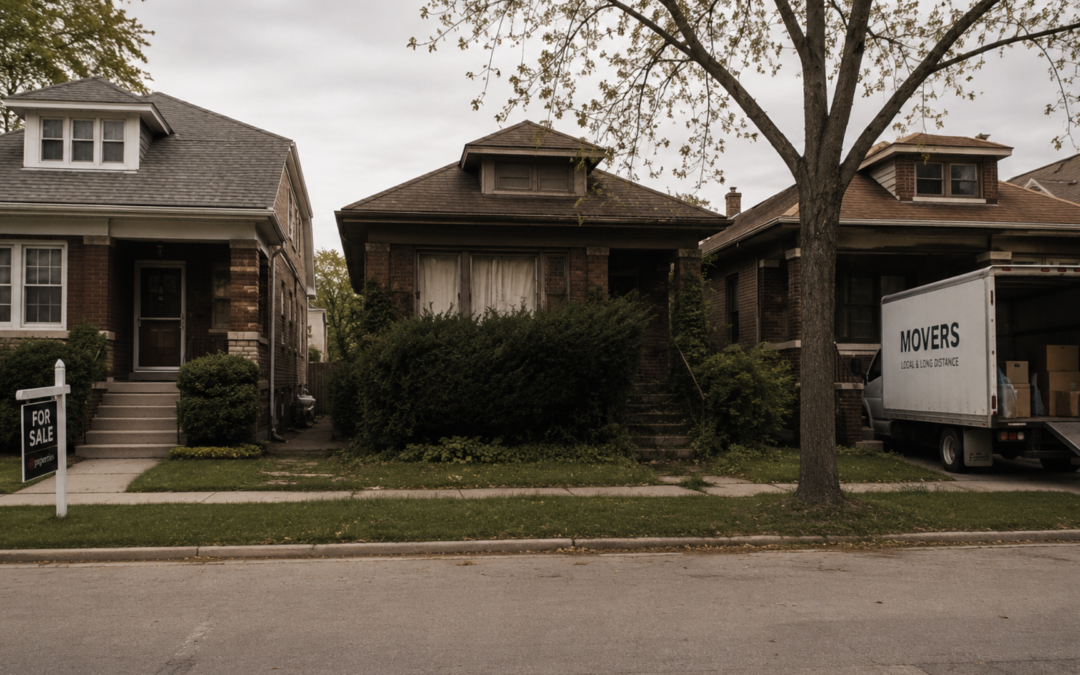
For many Chicago seniors, there is a particular kind of confidence that comes with owning a home for a long time. That feeling runs deep. You know where everything is. You know which drawer sticks and which floorboard creaks. The house fits around you like something worn in, comfortable, and entirely your own. And for years, that sense of belonging is enough to make the future feel like something you can deal with later.
And when people start asking what your plans are, it is easy to say the same thing. Not yet. There is still time.
That moment of reckoning arrives differently for everyone. It can come as a slow realization. It might arrive as a phone call that changes everything in a single afternoon. For some, it is a quiet Tuesday morning when you walk through the house and notice how much of it you no longer use.
These are three stories. None of them are meant to alarm you. But one of them might sound familiar.
Carol had a plan. Then the market shifted
Carol had lived in her Orland Park home for twenty-two years. She and her husband had raised two sons there. They refinished the basement twice and replaced the kitchen cabinets. Finally, in their late sixties, they started talking seriously about what came next.
The plan was simple enough. She wanted to wait until the boys had settled. She wanted the timing to feel right and the market to be in their favor.
The market looked good for a long time. There were years when her neighbors were selling quickly and well. Carol would watch the For Sale signs go up and come down and think, soon. Just not yet.
Then things shifted. Interest rates rose. Buyers pulled back. The home Carol had expected to sell in weeks sat on the market for four months. The single offer that came in was well below what she had been counting on.
She took it. By then, her husband’s health had changed. Waiting no longer felt like a strategy. It felt like a risk.
Carol’s regret wasn’t that she sold. It was that she hadn’t chosen when. The decision she had imagined making on her own terms ended up being made for her. There is a difference between selling a home and choosing to sell a home. Carol understood that difference clearly by the end, and it stayed with her.
Raymond thought his kids would help him figure it out
Raymond had lived alone in his three-bedroom home in Matteson since his wife passed five years earlier. His daughter was in Atlanta. His son lived about an hour away in Naperville. They spoke regularly, and all agreed that at some point, things would need to change. Nobody quite agreed on when, and nobody pushed the conversation forward.
Raymond told himself he would know when the time was right. He would feel it.
What he felt instead, two winters later, was the ceiling leaking after a heavy snowstorm. He stood in the hallway watching water come through the drywall. His first call was to his son, who drove over that same evening. They stood together without saying much for a long moment.
The conversation they had been putting off started that night. It wasn’t the version either of them would have chosen. But it was honest, and it moved quickly once it began. Raymond said later that the hardest part wasn’t the move itself. It was realizing how long that conversation could have been happening. A quiet Sunday afternoon would have been a much better place to start.
Raymond moved into a 55+ community in the south suburbs eight months later. He will tell you, without hesitation, that he loves it. The social life alone was something he hadn’t expected. He had lived alone for five years, and the difference in his day-to-day quality of life surprised him. But he also says he wishes the conversation had started before the ceiling gave him a reason to have it. The outcome was good. The path there was harder than it needed to be.
Denise didn’t think the numbers would change as much as they did
Denise was a careful, practical woman. She had spent thirty years as an office manager. Her files were always in order, and her bills paid on time. She assumed that when she was ready to sell her home in Tinley Park, she would sit down, run the numbers, and make a calm decision.
What she hadn’t tracked was how the numbers were shifting while she waited.
Her property taxes had gone up three times in six years. Two significant repairs, the furnace and then the roof, had come out of savings she had planned to use elsewhere. When she finally sat down with a financial planner in her early seventies, she realized her picture was based on figures that were years out of date.
She wasn’t in trouble. Nothing was dire. But the flexibility she had assumed she would have had quietly narrowed. A particular neighborhood, a specific type of community, a certain price point, some of the options she had pictured for herself were no longer quite within reach.
She adapted and found something she was happy with. The community she chose in the south suburbs suited her well, and she settled in more easily than she had expected. But she will tell you honestly that the process felt more pressured than it should have. Decisions that could have been made thoughtfully over months ended up being made in weeks. That difference matters more than people realize when you are choosing somewhere you will genuinely call home.
What these three stories have in common
Carol, Raymond, and Denise are not unusual. Like so many Chicago seniors navigating this season of life, they were thoughtful people who fully intended to get to it. Their situations come up again and again among homeowners across Chicago and the South Suburbs.
None of them made a dramatic mistake. Life simply moved at its own pace. The window they had imagined stayed open a little less longer than they expected.
What is worth paying attention to is not the outcomes. All three of them landed somewhere good. What matters is the gap between the decision they had imagined making and the one they actually got to make. That gap is almost always created by time. Time, more than the market or the finances or the family dynamics, is the one thing you cannot get back once it has passed.
Each of them said the same thing, in different ways. They wished they had started the conversation earlier, not to rush anything or because there was an emergency, but simply to understand what their options looked like while they still had the freedom to choose between them.
For Chicago seniors, especially, that window of choice is worth protecting. Knowing your options is not the same as committing to anything. As an SRES®, I work with homeowners across Chicago and the South Suburbs who are ready to explore what comes next at their own pace. A good starting point is the free resource page, where you will find guides and tools to help you think things through. It just means that when the moment comes, and it always does, you are the one deciding.
Prefer watching instead of reading? This auto-generated video summarizes the key points discussed in this article.
If you’re starting to think about what comes next, you don’t have to figure it out on your own. Sometimes it helps just to talk things through.
You can always take the next step at your own pace, with no pressure and no expectations. I’m always happy to help you get a clearer picture of your options.
Michelle Williams is a REALTOR® and SRES® serving Chicago and the South Suburbs, helping homeowners 50+ make confident decisions about their next move.