
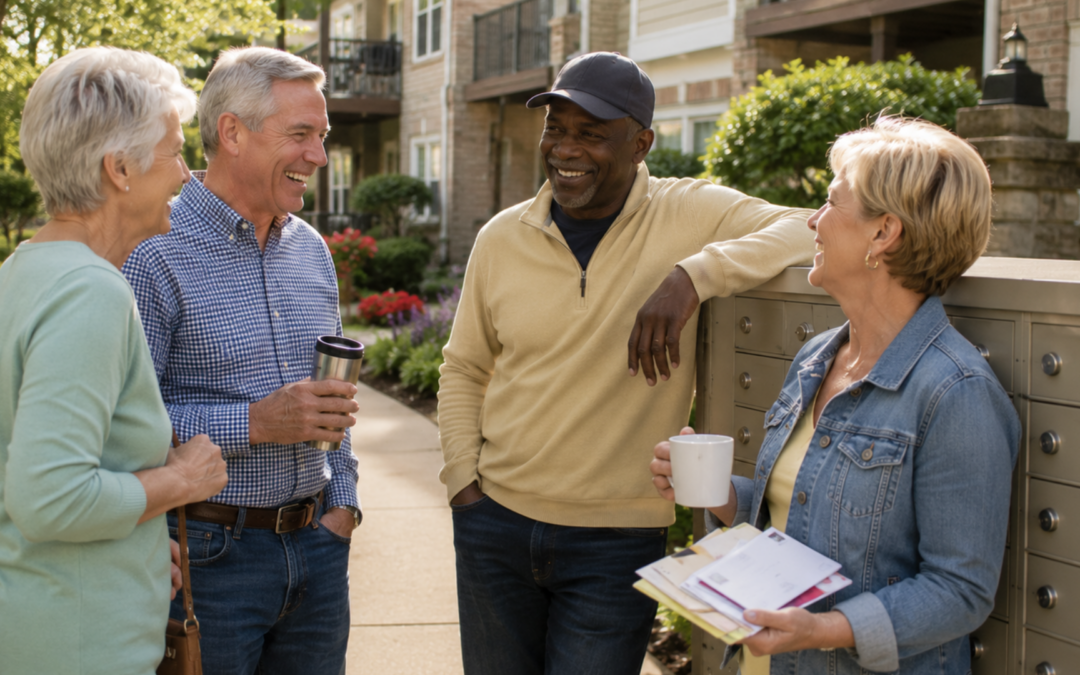
Senior community Chicago homeowners worry about losing is one of the top reasons people put off a move they otherwise know is right. The fear makes sense on the surface. Familiar faces, decades of history, the corner store where everyone knows your name. Here is the myth, though. Moving does not erase your community. Often, it simply gives you a new one, and sometimes a stronger one than what you left behind.
Where This Myth Comes From
Nobody invents this fear out of nowhere. Leaving a longtime home does mean leaving behind certain relationships, at least in their current form. That part is real. However, the myth stretches that truth into something bigger. It suggests that community itself cannot survive a move, or be rebuilt somewhere new.
In reality, community was never really about the address. Instead, it was about the people, the routines, and the shared experiences that built those relationships over time. All three of those things can travel with you. Often, new versions of them form faster than people expect.
This myth tends to be loudest right before a decision gets made, and quietest afterward. Homeowners who have already gone through a move rarely describe losing their community. Instead, they describe a period of adjustment, followed by a new routine that eventually felt just as natural as the old one. Ask almost anyone a year or two after their move, and the story tends to be the same: harder than expected at first, then surprisingly workable, then eventually just life again.
It helps to separate two fears that tend to get bundled together here. One is the fear of losing specific people you love. The other is the fear that you personally will never feel connected anywhere again. That first fear is manageable with a phone call and a calendar. The second fear, though, does most of the damage. It is also the one the research speaks to most directly.
What the Research Actually Shows
A peer-reviewed study published in BMC Geriatrics looked at older adults who joined a community group after a major life event. That event often included moving house. Within just one year, these new members saw a significant reduction in loneliness. Notably, participants specifically named moving as one of the life events that made new group connections especially valuable, not especially difficult.
That finding cuts directly against the myth. Instead of moving being the thing that isolates people, it is often the very thing that motivates them to build new connections. A move does not close a door on community. Frequently, it opens one instead.
The same study found something else worth mentioning. Participants who joined a group after retiring, losing a spouse, or moving all described feeling like their social world had already shrunk before they joined. In other words, isolation had usually started while they were still in the old, familiar house. The move was not the cause. It was often the turning point.
Why New Communities Can Form Faster Than Expected
Research compiled by 55places.com found something similar. Older adults consistently report that making friends becomes easier once they move into a community built around shared activities and regular interaction. Retirement itself already changes daily routines. This frees up time for the kind of casual, repeated contact that friendships are actually built on.
This matters because friendship formation depends heavily on frequency, not just chemistry. According to AARP’s guide to making friends after 50, simply showing up in the same place again and again tends to be one of the most reliable paths to real friendship. A walking group, a class, a regular coffee spot, any of these work. A new neighborhood with built-in gathering spaces can actually speed up that process. Compare that to a longtime neighborhood, where routines calcified decades ago and everyone already has their own established circle.
It is worth noting that this is not about pretending old age makes friendship easy. It usually takes more intention at this stage of life than it did at twenty five, when proximity alone did most of the work. What has changed for the better, though, is time. Retirement and downsizing both tend to free up hours that used to go to work and home maintenance, and those hours are exactly what new friendships need most.
The Role a Senior Move Manager Can Play
Community rebuilding does not have to happen entirely alone, either. The National Association of Senior and Specialty Move Managers represents professionals who help older adults transition into new homes and neighborhoods. Part of that work often includes connecting new residents with local resources, activities, and groups. As a result, the social side of a move gets support from day one instead of being left to chance.
This kind of help matters because the hardest part of rebuilding community is usually just knowing where to start. A resource that points you toward the right walking group, the right library program, or the right neighbor can shortcut months of uncertainty into a few confident first steps. Many families never think to ask about this kind of support until well after the move, when the boxes are unpacked and the harder question of building a new social life is suddenly the only thing left.
What Actually Happens After the Move
I have written before about the surprising things people never expected to love about their smaller home. Community often shows up on that list in ways people did not anticipate. A shorter walk to a neighbor’s front door tends to matter more than expected. So does a smaller building with more shared spaces. Even a community room hosting a weekly card game can become the thing nobody knew they would look forward to.
None of this means the old community stops mattering. Long-standing friendships can survive a move just fine. A phone call, a regular visit, or a standing lunch date all help. What changes is simply that a new set of relationships gets added, rather than the old ones being erased entirely. In this sense, community is not fixed to a location. Rather, it grows wherever you keep showing up.
Many homeowners describe a similar arc after settling into a new place. The first few weeks feel unfamiliar, sometimes even a little isolating, before a handful of small, repeated interactions start to add up. A neighbor who waves every morning. A regular face at the mailboxes. None of these moments feel significant on their own, but together they quietly rebuild the sense of belonging people worried they would lose.
The Real Question Worth Asking
If fear of losing your community is the main thing holding you back, it is worth asking a more specific question. Is the current home actually preserving your community? Or is it simply familiar? Those are not always the same thing. The difference matters more than most people realize until they have already made the move.
A familiar house can quietly host a shrinking social circle without anyone noticing, especially as neighbors move away, friends pass, or health limits how often people can gather the way they used to. Familiarity feels safe, but it is not the same thing as connection, and confusing the two is exactly how this myth manages to survive as long as it does. The house stays the same. The neighborhood around it, though, keeps changing whether anyone moves or not.
Sometimes the most connected version of your life is still ahead of you. It is not behind you, in a house you have simply grown used to. The myth says otherwise, but the research, and the experience of homeowners who have already made the move, tends to say something far more hopeful.
When you are thinking about your next move, the free resource library has practical guides covering every aspect of later-life housing, from downsizing and aging in place to senior living options, care alternatives, and the resources you need to make confident decisions. And if you would like to understand how I work with homeowners over 50, the Homeowners 50+ page is the right place to start.
Prefer watching instead of reading? This auto-generated video summarizes the key points discussed in this article.
If you’re starting to think about what comes next, you don’t have to figure it out on your own. Sometimes it helps just to talk things through.
You can always take the next step at your own pace, with no pressure and no expectations. I’m always happy to help you get a clearer picture of your options.
Michelle Williams is a REALTOR® and SRES® serving Chicago and the South Suburbs, helping homeowners 50+ make confident decisions about their next move.