
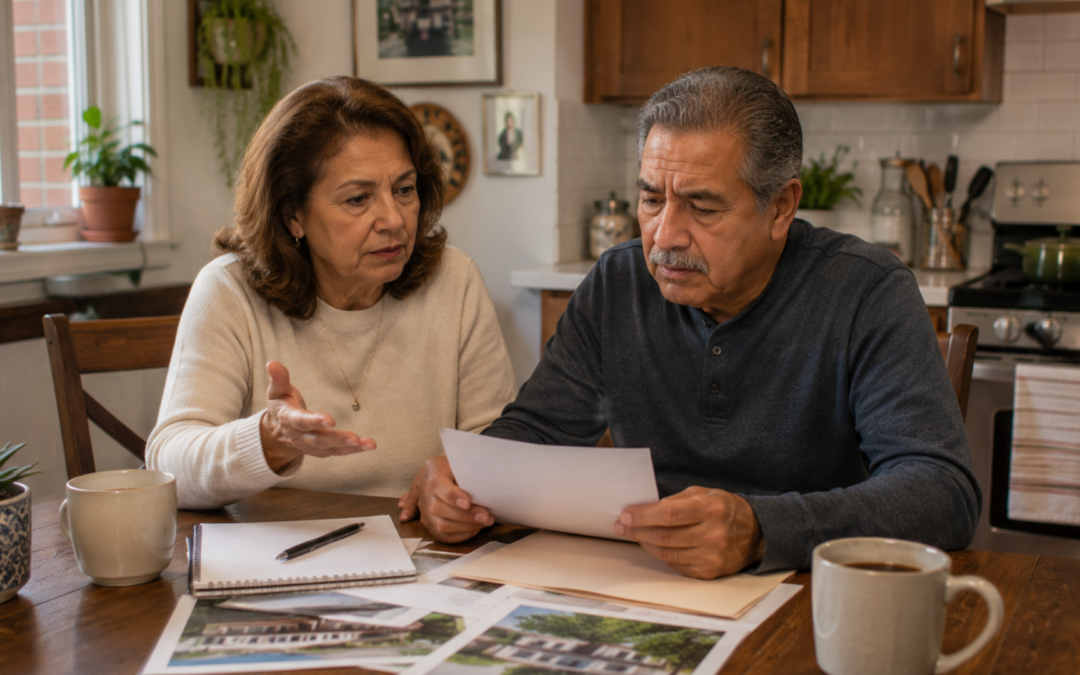
There’s a conversation that happens in a lot of homes, and it almost never starts with the word “moving.” For Chicago couples, it often starts with something smaller. A comment about the stairs. A Saturday spent doing yard work that used to take an hour and now takes most of the day. A quiet moment in a bedroom that once belonged to a child who has been gone for fifteen years.
One person in the house has started doing the math. The other one isn’t ready to pick up the pencil.
Research from AARP’s 2024 Home and Community Preferences Survey found that while nearly two-thirds of adults over 50 say downsizing is worth considering, 75% still want to stay in their current home as they age. That tension lives in real households, in real conversations, between two people who love each other and want very different things, at least for now. It is also worth saying clearly: there is nothing wrong with either person. Not the one who wants to move. Not the one who doesn’t. What matters is understanding where each of you is coming from, because the house isn’t just a building. For most people over 50, it is a chapter of their life. Sometimes it feels like the whole book.
The Couple Who Couldn’t Agree on the Timing
Sandra had been thinking about it for about two years. The house was a four-bedroom in the south suburbs, and she and her husband Ray had raised three kids there. She loved it. She still loved it. But she also knew that the heating bills were getting harder to justify, the master bathroom needed work they hadn’t budgeted for, and her knees weren’t getting any younger.
Ray wasn’t against moving in principle. He just wasn’t ready right now. He had a workshop in the garage he’d spent twenty years building out. The neighbors were friends, not just faces. The church they attended was three blocks away. For Ray, moving felt less like a fresh start and more like closing something he wasn’t finished with yet.
Sandra didn’t push. Instead, she suggested they just look at the numbers together, with no commitment attached. No showings. No agent visits. Just a quiet conversation about what their options actually were. What they found surprised them both. They had more equity than they’d realized. The market in their area was stronger than they’d expected. There were communities less than twenty minutes away that would have put Ray within easy reach of everything he cared about.
They didn’t decide that day. But they started talking, really talking, and that changed things.
The Couple Who Had Already Decided — But on Different Timelines
Margaret and her husband Dennis had both agreed they would eventually downsize. That word “eventually” was doing a lot of work in their house.
For Margaret, eventually meant this year. She was tired of the maintenance, tired of cleaning rooms nobody used, and genuinely excited about the idea of a smaller, simpler space. For Dennis, eventually meant in a few years, once he retired fully and had time to sort through the garage and finish a couple of home projects he’d been putting off.
What helped them wasn’t an argument or an ultimatum. It was a timeline they built together. They agreed on a date twelve months out and started working backward from it. Dennis got the runway he needed. Margaret got the commitment she needed. By the time they were ready to list, they were on the same page.
Getting there took a few honest conversations and some give on both sides. Having a shared target made all the difference.
The Couple Where One Partner Had Already Let Go
Not every situation is about reluctance. Sometimes one person has already moved on emotionally, and the other one is catching up.
Patricia had watched her mother decline in a home that was too large and too isolated, and that experience had stayed with her. When she brought up downsizing to her husband Carl, she wasn’t speaking from a spreadsheet. She was speaking from something she’d seen and didn’t want to repeat. Carl heard that. It took him a while to sit with it, but he heard it.
For them, the conversation wasn’t about the house at all. It was about what they wanted the next decade to look like, and who they wanted to be in it. Once they reframed it that way, the decision came more easily.
What Usually Helps
If you and your spouse are in different places about this, the first thing worth saying is: slow down. Don’t try to resolve it in one conversation. The disagreement is almost never really about the house. It’s about identity, security, memory, and what comes next. Those are big things, and they deserve room to breathe.
A few things that tend to help:
Talk about what you’d be moving toward, not just what you’d be leaving. A lot of resistance softens when the conversation shifts from loss to possibility.
Look at the numbers together, with no pressure to act. Understanding your equity and your options gives both people something solid to stand on, rather than talking in the abstract.
Give the reluctant person a role in the process. When one partner feels like this is happening to them rather than with them, the resistance usually gets stronger. When they feel like co-pilots, it changes.
Knowledge helps too. Understanding what downsizing actually involves, before any decisions are made, can take a lot of the fear out of the conversation. These two free guides are a good place to start: The Upside of Downsizing walks through the real benefits of making the move, and 10 Ways to Make Downsizing a Bit Easier gives you a practical, step-by-step look at what the process actually looks like. No commitment required, just information.
According to a Baylor University study on how older couples make downsizing decisions, couples who intend to age in place until the end often ultimately make a different decision, but they get there gradually, through repeated conversations rather than a single turning point. That tracks with everything the research tells us about how these decisions actually unfold in real life.
A Final Thought
There is no right pace for this. Some couples spend six months talking before they feel ready to take a single step. Others move quickly once the conversation finally opens up. What matters is that both people feel heard, not just managed.
If you’re in the middle of this right now, one of you reading this alone while the other one isn’t quite there yet, know that you’re not unusual. This is one of the most human conversations there is.
Prefer watching instead of reading? Watch a quick video summary of this article.
If you’re starting to think about what comes next, you don’t have to figure it out on your own. Sometimes it helps just to talk things through.
You can always take the next step at your own pace, with no pressure and no expectations. I’m always happy to help you get a clearer picture of your options.
Michelle Williams is a REALTOR® and SRES® serving Chicago and the South Suburbs, helping homeowners 50+ make confident decisions about their next move.